
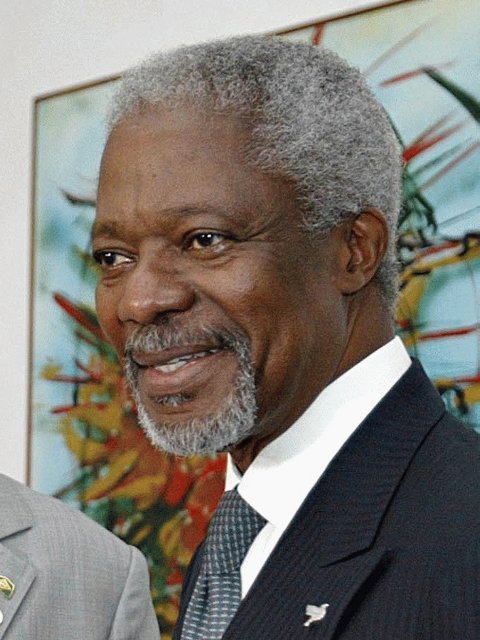
Kofi Annan: Global Statesman, Multilateral Reformer, Moral Voice in International Governance
Kofi Atta Annan stands among the most consequential figures in modern international governance. His career marked a decisive moment in global history: a period when leadership from the Global South—particularly Africa—moved from the margins to the centre of multilateral decision-making. Annan’s legacy is not defined by symbolism or representation alone, but by structural influence—the ability to shape institutions, norms, and global priorities from within.
Born in Kumasi, Ghana, in 1938, Annan came of age during Africa’s transition from colonial rule to independence. His journey—from a newly sovereign African state to the highest office in global diplomacy—captures a broader shift in international affairs: the gradual recognition that global governance must reflect the full diversity of the world it seeks to serve.
Field of Influence
International Governance & Diplomacy
With enduring impact across peacekeeping, human rights, development, and global ethics
Global Leadership & Institutional Authority
Secretary-General of the United Nations (1997–2006)
Kofi Annan served two full terms as the 7th Secretary-General of the United Nations, a role that placed him at the centre of the world’s most complex political, humanitarian, and security challenges. His appointment was historically significant in two respects:
-
He was the first Secretary-General to rise through the internal ranks of the United Nations, bringing deep institutional knowledge to the office.
-
He was the first Africa-born Secretary-General from Sub-Saharan Africa, reinforcing the legitimacy of African leadership in global systems.
As Secretary-General, Annan exercised authority over a vast and intricate system comprising:
-
More than 190 member states
-
Global peacekeeping missions operating across multiple conflict zones
-
Humanitarian and development agencies responding to crises worldwide
-
International security and diplomatic frameworks shaping global stability
His leadership was substantive rather than ceremonial. Annan played a direct role in shaping the United Nations’ responses to:
-
Armed conflicts and post-conflict transitions
-
Humanitarian emergencies and mass displacement
-
Global development priorities
-
Emerging security threats in an increasingly interconnected world
Contribution to International Systems & Policy
Reforming Peacekeeping & Humanitarian Response
Annan prioritised reform of UN peacekeeping at a time when international intervention was under intense scrutiny. He pushed for:
-
Clearer mandates for peacekeeping missions
-
Improved protection of civilians, particularly in conflict zones
-
Greater accountability within UN operations
His tenure coincided with some of the most challenging peacekeeping environments of the late 20th and early 21st centuries. These experiences forced the international community to confront difficult questions about responsibility, effectiveness, and the moral limits of non-intervention.
Human Rights & Global Responsibility
Kofi Annan emerged as a central advocate of the principle that:
State sovereignty cannot serve as a shield for mass human rights violations.
This position helped shape the intellectual and moral foundations of the Responsibility to Protect (R2P) doctrine, which later became a cornerstone of international human rights and humanitarian law. While controversial, R2P reflected Annan’s insistence that the global community bears collective responsibility when states fail to protect their populations from atrocity crimes.
Development & Global Equity
Annan was instrumental in elevating development from a peripheral concern to a central pillar of global governance. He championed the Millennium Development Goals (MDGs), which:
-
Placed poverty reduction, health, education, and gender equality at the heart of international policy
-
Introduced measurable benchmarks for global development progress
-
Fostered coordination across governments, NGOs, and multilateral institutions
The MDGs reshaped how development was conceptualised and assessed, influencing subsequent global frameworks, including the Sustainable Development Goals.
Recognition Beyond National Scope
Nobel Peace Prize (2001)
In 2001, Kofi Annan and the United Nations jointly received the Nobel Peace Prize, in recognition of their work to:
-
Revitalise the UN
-
Advance human rights
-
Promote a more peaceful and organised world
The award affirmed Annan’s stature as a global moral authority, not merely an administrator or consensus-builder.
Post-UN Global Influence
After leaving office, Annan continued to exert influence well beyond formal institutional roles. Through the Kofi Annan Foundation, he focused on:
-
Peace and conflict resolution
-
Sustainable development
-
Human rights
-
The rule of law
He also undertook high-level mediation and advisory roles, including involvement in:
-
Kenya’s post-election crisis (2007–2008)
-
International efforts toward peace in Syria
-
Global initiatives on election integrity and democratic governance
His counsel was sought precisely because of his credibility, independence, and capacity to operate above partisan or national interests.
Cross-Border & Continental Significance
Kofi Annan’s influence extended far beyond his country of birth. His work:
-
Shaped global institutions, norms, and policies
-
Elevated the presence and legitimacy of African leadership within multilateral systems
-
Challenged assumptions about where authoritative global leadership can originate
He became a reference point for:
-
African participation in international governance
-
Ethical leadership under global pressure
-
The possibility of principled authority within complex and often contested institutions
Afrispora Assessment
Kofi Annan meets all Afrispora qualification criteria:
-
Leadership and influence within a global institution
-
Contribution to international systems and policy
-
Cross-border and continental relevance
-
Recognition at the highest global level
He represents Afrispora in its most archetypal form: an Africa-born individual whose work reshaped global governance itself.
Kofi Annan’s Enduring Legacy and Its Relevance to Afrispora News
Kofi Annan’s impact goes beyond a career of leadership; it’s a narrative that defines Africa’s role in shaping global governance and diplomatic frameworks. His career epitomizes the transformative power of Africa-born leadership in international institutions and provides an enduring example of moral integrity and strategic diplomacy.
Annan’s story is not simply biographical; it is institutional history. It demonstrates that:
-
Africans can lead global systems with authority and integrity
-
Multilateral institutions can be shaped from within
-
Moral leadership remains possible at the highest levels of power
For Afrispora News, Kofi Annan is more than a featured figure. He is a benchmark against which Africa’s global contributions can be understood, assessed, and remembered.
Share this:
- Click to share on Facebook (Opens in new window) Facebook
- Click to share on X (Opens in new window) X
- Click to share on LinkedIn (Opens in new window) LinkedIn
- Click to share on Tumblr (Opens in new window) Tumblr
- Click to share on Pinterest (Opens in new window) Pinterest
- Click to share on WhatsApp (Opens in new window) WhatsApp
- Click to share on Bluesky (Opens in new window) Bluesky
- Click to share on Threads (Opens in new window) Threads
