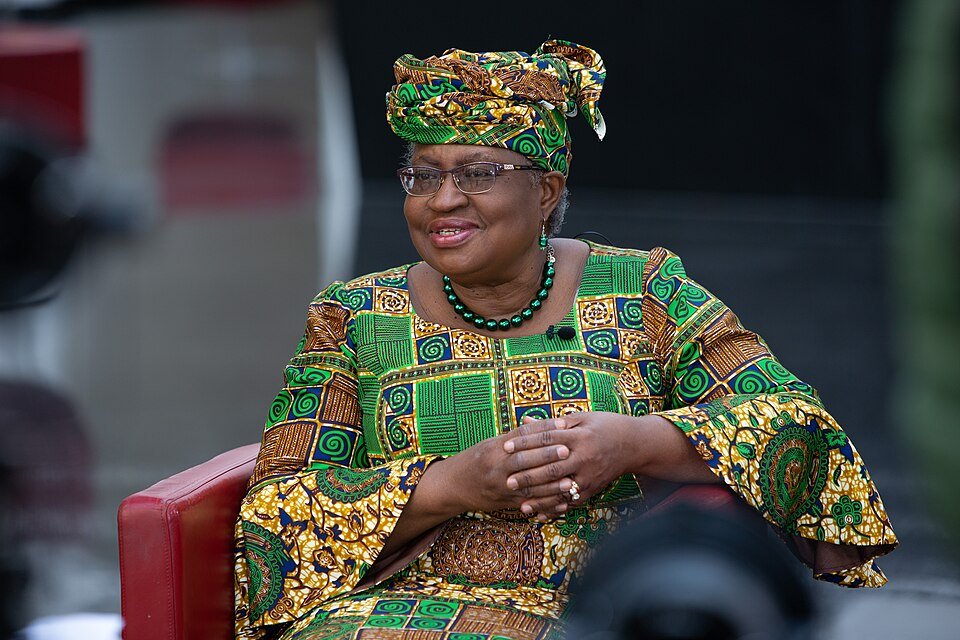
Ngozi Okonjo-Iweala’s journey from a Nigerian village to the helm of the World Trade Organization is one of the clearest examples of African leadership reshaping the architecture of global economic governance.
Roots, education and early multilaterals
Born in 1954 in Ogwashi-Ukwu, Delta State, Nigeria, Ngozi Okonjo-Iweala grew up in a family of academics and experienced the Biafran war as a child, an early encounter with fragility that sharpened her sense of how macroeconomic decisions impact ordinary lives. She left Nigeria for the United States to study economics at Harvard University (AB, 1976) and later earned a PhD in regional economics and development from the Massachusetts Institute of Technology in 1981, focusing her research on African development challenges. Okonjo-Iweala then spent 25 years at the World Bank, rising from a young development economist to Managing Director, responsible for portfolios in Africa, Europe and Central Asia, South Asia and the Middle East and North Africa. This experience made her one of the most visible African faces in global development finance.[
Reforming the “unreformable”: Nigeria’s finance minister
Okonjo-Iweala twice served as Nigeria’s Minister of Finance (2003–2006 and 2011–2015), becoming the first woman to hold that office and, briefly, the country’s first female foreign minister. In her first term she led negotiations with the Paris Club that secured an unprecedented deal: roughly 60% of Nigeria’s external debt to official creditors was written off, and the country paid off the rest, effectively exiting decades of rescheduling and arrears. She also promoted the use of an Oil Price–Based Fiscal Rule and the establishment of an Excess Crude Account, mechanisms designed to save windfall oil revenues and stabilise the budget, which were widely cited by international institutions as best practice for resource-dependent economies.
These reforms, however, remain contested domestically. Critics on the Nigerian left argue that the Paris Club deal transferred billions of dollars to creditors at a moment of high oil prices and that subsequent administrations eroded the discipline of the Excess Crude Account, questioning the sustainability and distributive impact of her policies. The January 2012 fuel subsidy removal, which she defended as necessary to curb an US$8 billion annual fiscal drain and entrenched corruption, triggered nationwide protests and a partial policy reversal, underscoring the political volatility of technocratic reform in a context of deep popular distrust.
Global boards, climate and vaccine equity
After leaving the World Bank and before taking up her WTO post, Okonjo-Iweala wove together roles across global boards and initiatives that positioned her squarely at the intersection of development, climate and health. She chaired the board of Gavi, the Vaccine Alliance, from 2016 to 2020, overseeing a period in which the organisation reported having supported the immunisation of hundreds of millions of children and saving an estimated millions of lives in low- and middle-income countries. At the same time she chaired the board of the African Risk Capacity, a specialised African Union agency that provides sovereign insurance against climate-related disasters, and co-chaired the Global Commission on the Economy and Climate, arguing that climate action and economic development can be mutually reinforcing.
In the private sector, she served as a senior adviser at the financial advisory firm Lazard and sat on the boards of Standard Chartered PLC and Twitter Inc., adding corporate governance experience in global finance and technology to her public-sector profile. During the COVID‑19 pandemic she was appointed both African Union and WHO Special Envoy on COVID‑19, tasked with mobilising international support for African countries, advocating debt relief and emergency financing, and pressing for equitable access to vaccines and medical supplies.
Making history at the WTO
On 1 March 2021, Ngozi Okonjo-Iweala took office as the seventh Director-General of the WTO, becoming the first woman and the first African to lead the organisation—or its predecessor, the GATT—in its 80‑year history. Her election followed a fraught geopolitical process, including an initial block by the United States under the Trump administration, later reversed by the Biden administration, symbolising broader tensions over multilateralism and trade rules. As Director-General, she inherited an institution under pressure: the Appellate Body (WTO’s highest dispute settlement organ) was paralysed, trust between major trading powers was frayed, and many developing countries felt that trade rules were not delivering inclusive growth.
Okonjo-Iweala has articulated a clear reform agenda: revitalise the WTO’s dispute settlement system; update rules to reflect the realities of the digital economy, green transitions and the circular economy; and restore the organisation’s development mission so that trade once again becomes a lever for lifting people out of poverty. She has repeatedly pressed G20 leaders and other major economies to resist protectionism, reduce trade distortions—especially in areas such as agriculture and subsidies—and keep supply chains open for critical goods, from food to vaccines. Under her watch, members concluded the Fisheries Subsidies Agreement in 2022, the first WTO deal with an explicit environmental sustainability focus, though debates continue about its ambition and the need for a second wave of disciplines.
Critique, contestation and the politics of trade justice
Like her tenure in Nigeria, Okonjo-Iweala’s leadership at the WTO draws both admiration and criticism, often along ideological lines. Supporters in international policy circles highlight her blend of Global South experience and global institutional savvy, crediting her with injecting development language and climate and health concerns into trade debates that had long been dominated by narrow mercantilist calculations. They point to her efforts during the COVID‑19 crisis to broker compromises on intellectual property and supply-chain constraints, and to keep attention on the needs of low‑income countries facing rising food and fuel prices.
Critics, including some trade justice and labour groups, fear that her emphasis on restoring the credibility of the WTO may prioritise institutional stability over deeper structural change, especially around agricultural subsidies and policy space for industrialisation in Africa and other developing regions. Others in the global North worry that her calls for more flexible rules on digital trade, industrial policy and climate-related measures could undermine existing trade disciplines, reflecting the broader contest between established and emerging powers over the future of globalisation. This tension places Okonjo-Iweala at the centre of a debate that is as much about whose development model prevails as it is about tariffs or rules of origin.
Afrispora lens: African Agency Within the Global Economic Order
From an Afrispora perspective, Ngozi Okonjo-Iweala’s trajectory illuminates how African-born economists can move from national reform to shaping the global rules that govern trade, debt and development. Her career—stretching from Nigerian budget battles and debt negotiations to chairing Gavi and steering the WTO—embodies the idea that African expertise does not merely respond to external prescriptions; it can define agendas and language in spaces once closed to African voices. At the same time, the controversies around her legacy in Nigeria and the contested politics of WTO reform remind us that African leadership on the world stage is never insulated from domestic accountability or from the wider struggles over what a just global economic order should look like.
