
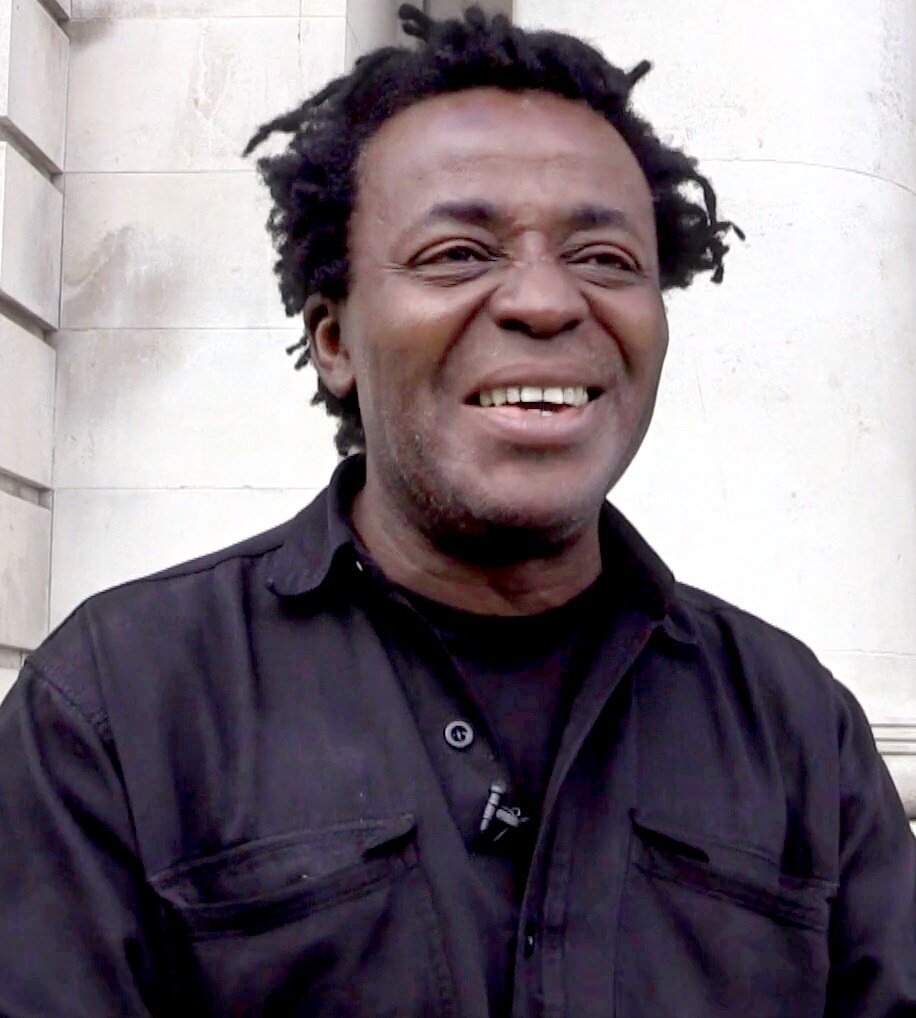
Sir John Akomfrah: From Ghana to Britain’s highest cultural honours, re-imagining migration as lived history
Sir John Akomfrah has spent four decades teaching Britain—and the world—how to see migration not as a “crisis,” but as a long, layered history of movement, memory and struggle that is written into the very fabric of modern life. For Afrispora News, he is a cornerstone figure in any serious account of African diasporic intellectual and artistic achievement.
From Ghana to the Black Audio Film Collective
Born in Accra in 1957 and raised in the UK, John Akomfrah emerged in the early 1980s as a founding member of the Black Audio Film Collective, a group of Black British artists and filmmakers formed in London in 1982. Working alongside collaborators Lina Gopaul and David Lawson, he used film, sound and archival experiments to probe how Britain’s Black communities were represented—and misrepresented—on screen.
The collective’s debut feature, Handsworth Songs (1986), examined the 1985 uprisings in Birmingham and London through a collage of archive footage, still images, newsreel and newly shot material, refusing the easy narratives of “law and order” versus “riot” that dominated mainstream coverage. The film won the Grierson Award for Best Documentary in 1987 and is now widely regarded as a classic of political documentary and Black British cinema.
In 1998, Akomfrah, Gopaul and Lawson co‑founded Smoking Dogs Films, the production company through which many of his later works have been realised, extending his practice from broadcast and cinema into gallery‑based, multi‑screen installations.
Memory, migration and the aesthetics of the archive
Akomfrah’s signature is a poetic, essayistic style that fuses archival footage, staged scenes, voice‑over and music into dense visual tapestries. Works like The Unfinished Conversation (2012), a three‑screen installation on cultural theorist Stuart Hall, and Vertigo Sea (2015), a three‑channel film first shown at the Venice Biennale, use the sea, weather and landscape as metaphors for both the violence and the possibility of movement.
In Vertigo Sea, Akomfrah juxtaposes images of oceans, whales and Arctic landscapes with archival material on the transatlantic slave trade, whaling and contemporary migration, turning water into a “reservoir of recollections” where histories of empire, extraction and displacement converge. Similarly, in works like Peripeteia (2012) and Mnemosyne (2010), he imagines Black figures wandering through European landscapes where we “do not expect to see them,” deliberately unsettling who is assumed to belong in canonical art history and geography.
As he explained in a recent interview around his British Pavilion installation, he is drawn to “subjects infused with memory and history,” and uses bricolage—the assemblage of found images, audio and texts—to “write history in unexpected ways.” This method allows him to create non‑linear, multi‑temporal narratives that connect slavery, colonialism, climate change and present‑day migration without flattening them into a single story.
Global recognition: Artes Mundi, Royal Academy and Venice
Akomfrah’s work has steadily moved from the margins of British broadcasting into the heart of the international art world. In 2017 he won the Artes Mundi Prize—the UK’s largest award for international contemporary art—for a body of work dealing with migration, racism and religious persecution, including the film Auto Da Fé, which traces 400 years of forced displacement through eight historical episodes. He has exhibited major installations at institutions such as Tate Britain, SFMOMA, the New Museum in New York, the Imperial War Museum (with Mimesis: African Soldier, on African troops in World War I) and many others.
In 2017 he was elected a Royal Academician and later appointed CBE, before being knighted in the 2023 New Year Honours for services to the arts. In 2023 the British Council announced him as the artist to represent Great Britain at the 60th Venice Biennale in 2024, with the exhibition Listening All Night to the Rain at the British Pavilion. The installation, composed of eight “cantos,” weaves together ecology, imperialism and migration, using archival and newly shot material to explore how sound and image can hold “collective memory” in a time of overlapping crises.
Afrispora lens: re‑inscribing Africa and its diaspora into world history
From an Afrispora News perspective, Sir John Akomfrah’s importance goes beyond his awards or institutional recognition. As a Ghanaian‑born, London‑based artist, he has re‑inscribed African and diasporic experiences into the visual record of modernity, challenging who is seen as a legitimate subject of history. By placing Black and migrant figures at the centre of works about the sea, the First World War, industrial landscapes and climate catastrophe, he refuses the idea that Africa is peripheral to global narratives.
His long collaboration with other diasporic artists through the Black Audio Film Collective and Smoking Dogs Films also models a distinct kind of Afrispora practice: collective, research‑driven, and deeply attentive to the politics of the archive and the ethics of representation. In an era where migration is often reduced to numbers and headlines, Akomfrah’s films return us to the texture of lives in motion—the songs, silences, weather and fragments of memory through which dispossession and belonging are actually felt.
For Afrispora News, documenting his work with clarity, dignity and historical integrity is essential. His oeuvre shows that African diasporic leadership is not only found in ministries, banks or multilateral agencies; it is also found in the patient, experimental re‑making of the images and stories through which the world understands itself.
